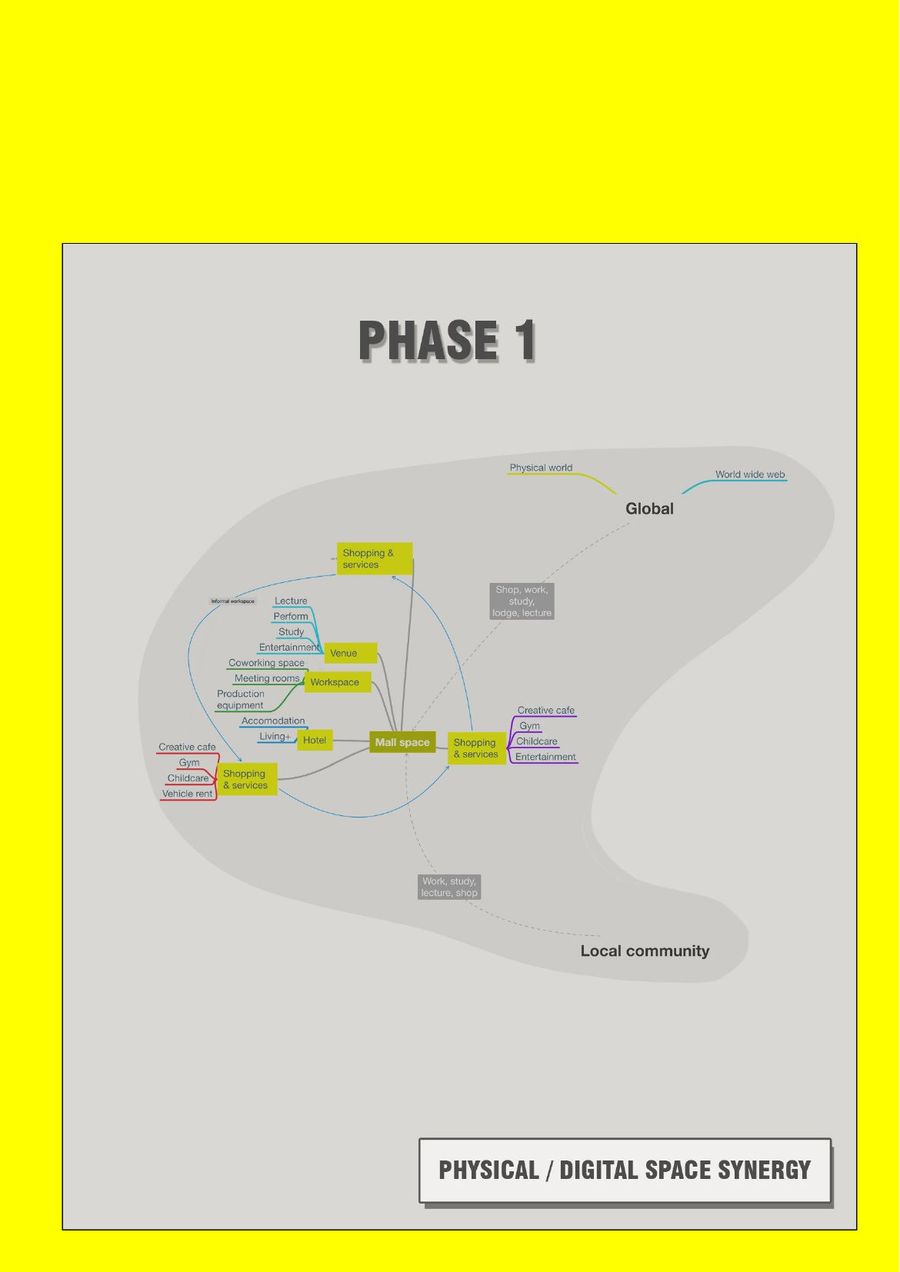
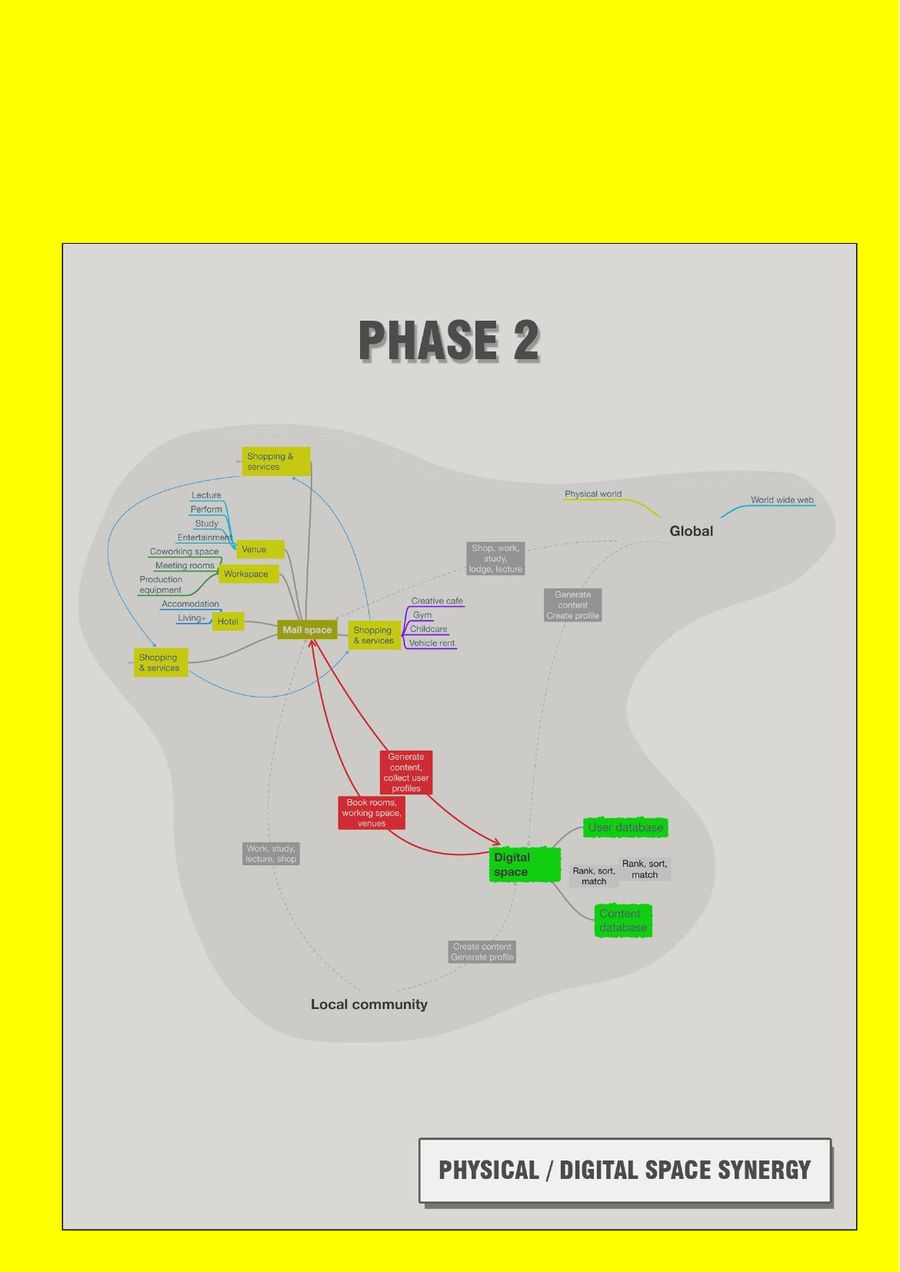
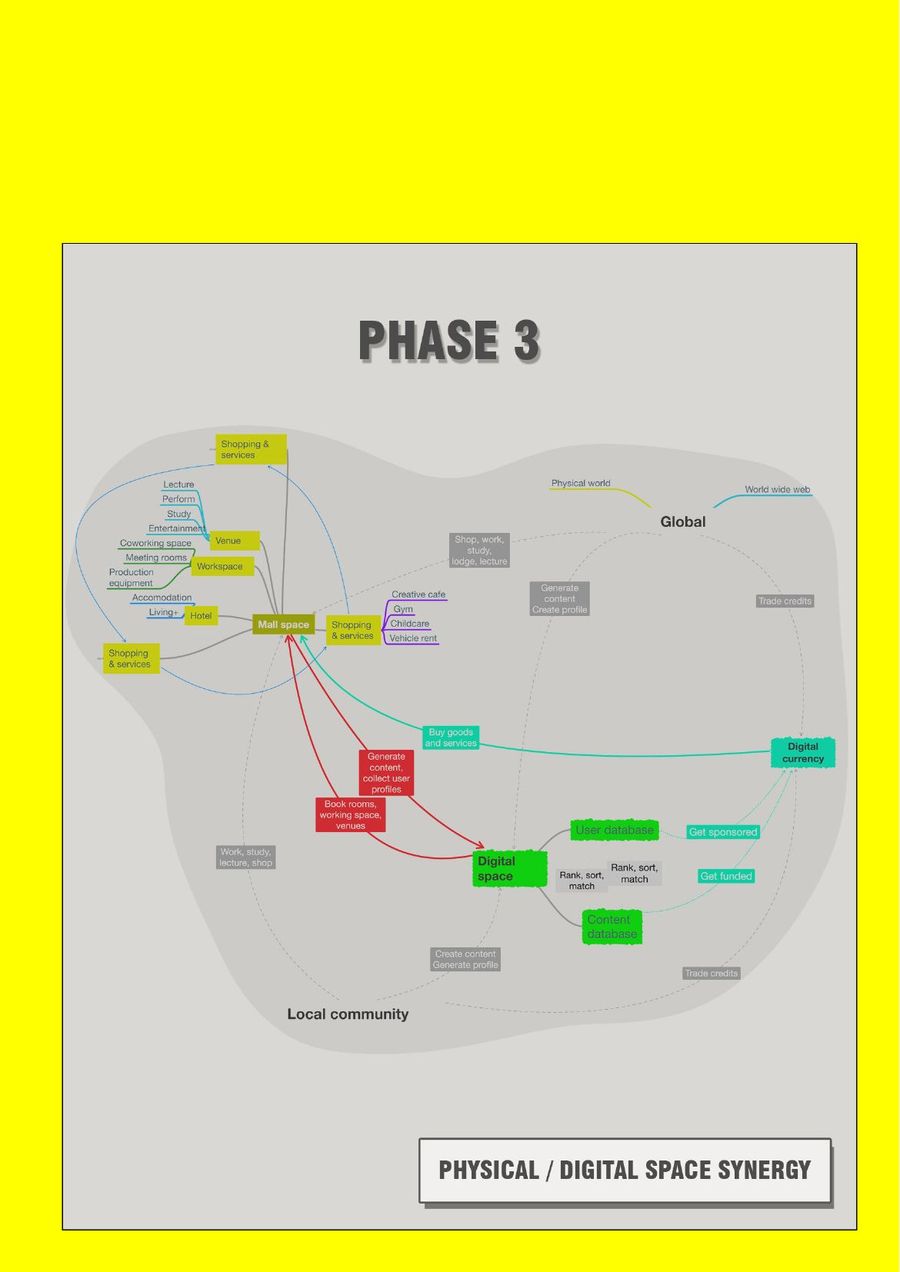
Mia is a design graduate who’s currently working as a barista in the Creative Cafe. She’s mostly interested in perks of the job, like having great discounts for workshops, exhibitions and lectures and having the chance to meet new people and develop her skills. Some of her work caught a lot of attention recently and she’s already daydreaming about Ambassadorship.
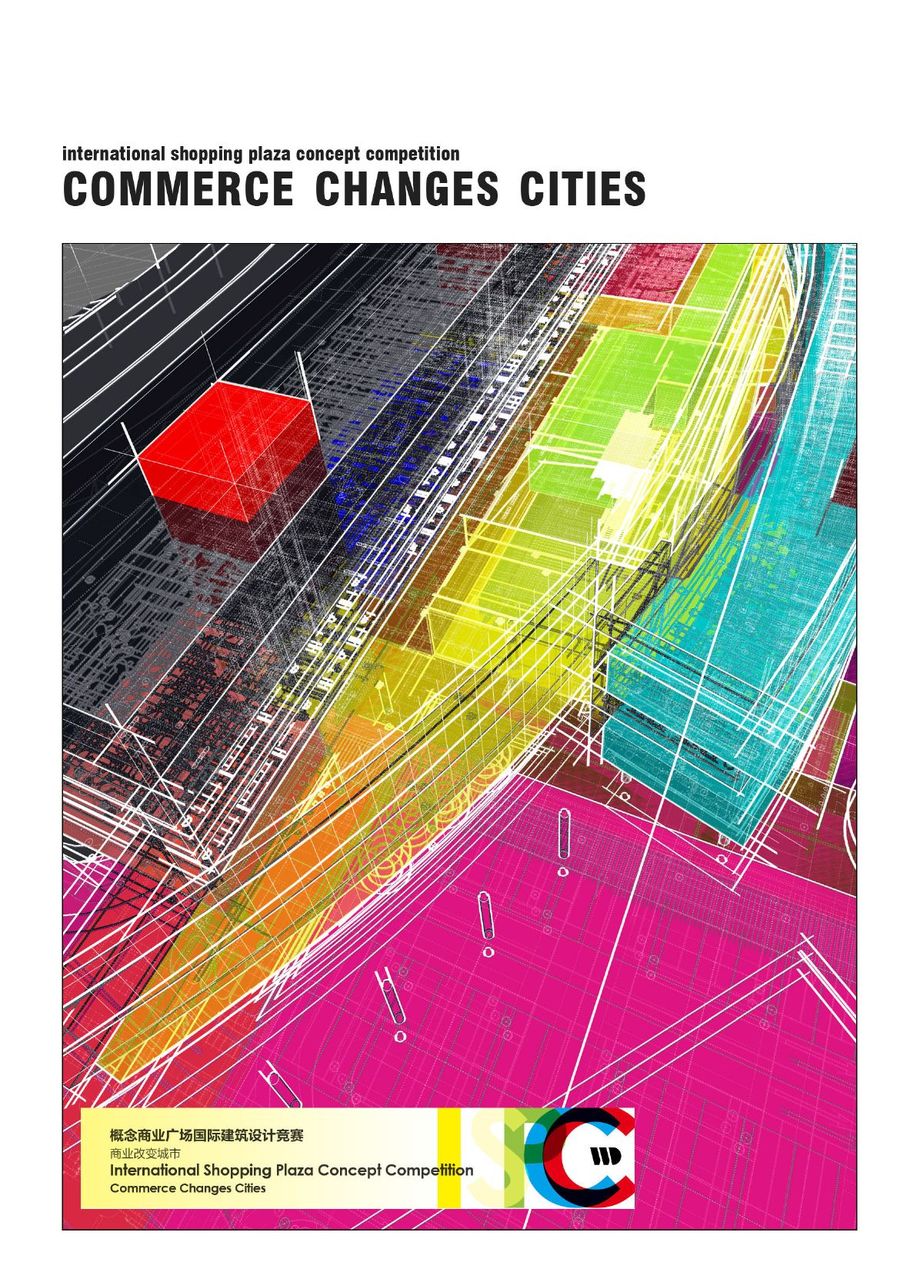
Commercechangescities
An essay on why the shopping mall worked, why it was failing, and what could take its place: a hybrid, a franchise of campuses, a network of embassies.
“As we look ahead into the 21st century, the leaders will be those who empower others.”Bill Gates
Challenge

Commercial spaces and retail in particular are vulnerable to market changes. As times change, business models rise and fall. The mall, once displacing the towering empires of mail order retail in the US, is today threatened to be itself displaced by online shopping. New habits, new tastes, new ways of living, dictate terms which pose both a threat and an opportunity for businesses.
Shopping facilities and commercial space in general are fundamentally an expression of the market. Market decisions depend crucially on highly specific and consequential knowledge. The escalating complexity and interdependence of the modern world means an increase in sheer volume of relevant knowledge. The knowledge required is highly diverse and cannot be abridged. The great challenge we face is of successfully collating and integrating that knowledge towards meaningful, purposeful action. Growing project complexity demands more incubation time in project research, design and development. However in the 3 or 5 year period it takes to develop a project, the market it was to address might not be there any longer or might be significantly different. From an investment standpoint this poses a considerable risk. How do we, whether architects, business planners or investors, respond to this climate?

This subject has been in the focus of our attention for several years. In this proposal we will try to give an overview of the nature of the challenge, the forces and factors that inform our decision making and finally suggest possible courses of action.
…in the 3 or 5 year period it takes to develop a project, the market it was to address might not be there any longer.Chapter one
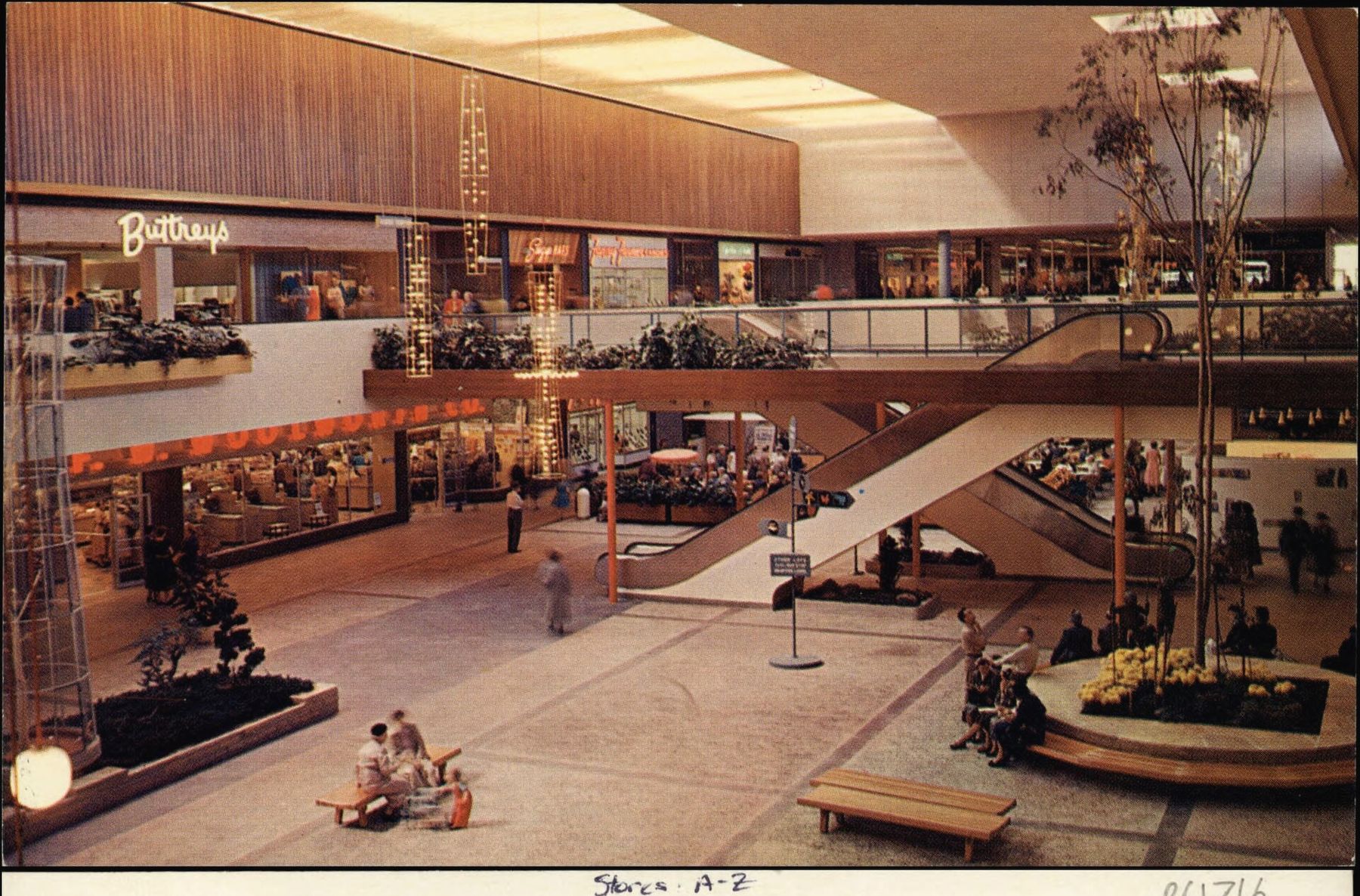
We look to history to understand how the mall originally came about and why it was successful in the first place. We extract the underlying principles of that success and apply them to new circumstances. The first fully modern shopping mall begins with Victor Gruen mid-20th century. Fundamentally, the mall was a response to social and economic circumstances in the post-WWII USA. The dream of a personal rural idyll, a house on the outskirts of town, white picket fence and the freedom of owning a car was in demand on a mass scale. The result was a rapid expansion of low density sprawl, and the expansion of cities went hand in hand with the surge of the automobile. It is this expansion that brought about the mall — a private surrogate to public community space which was lacking.
Gruen recognized the economic and sociological consequences of then present technological landscape. The ubiquity of the automobile meant shopping could be done at farther places and less frequently, enabled by availability of refrigeration. He also predicted behavior, that a fully enclosed and air-conditioned space would cause shoppers to linger longer and walk farther, thus spending more money — and all of these insights will be integrated into his design.

Initially working in New York, Gruen brought about key innovations to shop design, goods presentation and placement, and overall customer experience. This reimagined shopping experience is key for the mall’s success. Because, the mall was not only an outlet for shopping, but from a sociological and psychological standpoint, an arena for fulfilling an inherent human need for partaking in the “social theater”.
These are just some of the factors which made the shopping mall not only possible, but in retrospect, a seemingly imminent phenomena. In the same vein, in the following chapters we will give a concise summary and analysis of key parameters shaping our design approach. Those are the evolution of commerce, hybrid building types, work and employment, and finally the importance of place and tourism.
Shop
The recent decades have seen the undergoing of a profound change in social structure. A growing percentage of the populace in the developed world is living in some type of arrangement other than the traditional mother-father-child family. The way people socialize in general has changed, as weak social ties have replaced lasting commitments and strong bonds. The median age of marriage has shifted to 27 from 22 just a generation ago, and the number of married in this age bracket is half of what it used to be in 1968. There is little indication that these trends, and those that will shortly be discussed, will experience a sudden reversal. If anything they are likely to accelerate. And while there is a sizeable portion of the populace in older generations, the Millennial generation and the ones following are most relevant for the conception of the mall of the future.
The Millennial generation, now coming to its economic fruition, shows evident statistical discrepancies to previous generations. Home and car buying are postponed and pushed farther back on the priority list. A growing number of adults throughout ages 18-31 are living with their parents. The cost of education and other factors are the cause of a sharp rise in debt among this demographic. Often dubbed the renter generation, the millennials partake heavily in the share-economy and feel comfortable enjoying the service without the commitment of ownership. There is a relative scarcity of money in this age group compared to previous generations. The leitmotif of this group is therefore “value”, and seeking out value will come up again and again as the key to commercially addressing this demographic.
The current and the following generations of consumers are being brought up in a global world in which they are more conscious of the impact of their choices. Consumers have come to view purchasing as literal endorsement, so market transactions are increasingly gaining ethical and political overtones. More than ever the products we choose express who we are, communicating to the world how we see ourselves or how we wish ourselves to be seen by others. Consumers seek companies whose values are analogous to their own. They scrutinize material sourcing, working conditions, management practices as well as the social and environmental impact of a particular product or brand. The product has become a value statement, a message of one’s own identity. Wishing to be unique, consumers seek niche or limited edition products, locally produced or handmade, with stories they use to supplement their own personal story. In general, the consumers feel less loyalty to any particular brand than previous generations. Seeking value for their money, they heavily research the product of interest before purchase, not infrequently being more informed about the product than the salesperson. Often, the consumer will test the product in store, but ultimately purchase it from the cheapest vendor online, because with fewer expenses online retailers can afford smaller markups and offer competitive prices.
The purchase, thus, is the consequence of the shopping experience.Chapter two
Quite the contrary to automated cash registers or self-service trends, it is the service of skilled sales personnel that can be the key advantage of physical retail space as opposed to online shopping. But salesmen have to give actual value to the consumer, by being more knowledgeable and experienced than the consumer and by going the extra mile in customer treatment. In this case the consumer will reward the vendor with their business.
A great way to bring value to the future consumer is by curating their shopping experience. The consumer wants choice but also wants simplicity. A skilled and motivated salesperson should be the one on whom the consumer relies to narrow down the cornucopia of choice and styles. Like an art curator, a salesperson can interpret and piece together the statement which the consumer wants to project to the world. The skilled salesperson should be an invaluable asset to any retail business, and their qualifications will need them to be genuinely experienced and well versed in global trends, culture and communication.
In abstract terms, shopping, the exchange of money for goods or services should not be viewed as an activity in space but as a consequence. Shopping should not be viewed as the substance-like function contained within space, but more like air-conditioning: an all permeating amenity of space. In order to compete with online shopping, retail stores need to offer tangible and relevant value to the consumer. Information is free and is ubiquitous so it’s of little real value to the consumer. On a fundamental level the consumer doesn’t buy goods and services, they buy the benefits of goods and services. And the best way to convince the customer of those benefits is by offering them the firsthand experience of those future benefits. Victor Gruen’s lesson in the power of reimagining the shopping experience cannot be overlooked. Retail, in order to compete with the speed and convenience of online shopping, should really be about devising experiences for prospect consumers, while everything experienced can be bought. The purchase, thus, is the consequence of the shopping experience.
Hybrid
Shopping centers vary according to their size, geographic context and type of goods and services they have on offer. Strategies used for reimagining and futureproofing city center malls might not necessarily be applicable to regional malls, which serve less urbanized areas, and vice versa. With the arrival of 3D printing technology, shopping centers could very well become production centers, where the community benefits the use of high-tech production technology. The malls of the future might not only be selling or producing wares, but also growing produce, synthetic meat and other goods, as well as having a role in energy harvesting, storage and distribution.
It is difficult to give reliable economic forecasts because the future increasingly depends on technology, and has consequently inherited its rapid change and obsolescence cycle. In this climate of uncertainty the modernist architectural philosophy of “form follows function” is a liability. As Robert Venturi said, form should not follow function like a glove, around each finger, but like a mitten — it should allow some “wiggle room”. Closely sculpting spaces for certain functions which may drastically change overnight is a fragile development strategy. The more uncertain the function, in fact, the more wiggle room i.e. flexibility is needed. Form need not follow function, but contain it. Ultimately, the opposite maxim seems much more futureproof: “function follows form”.
The modernist approach to space flexibility was an “empty box” paradigm, in which theoretically anything can happen. But as time passes and the box is gradually inhabited by certain programs, the once theoretically limitless possibilities become more and more narrow. Not to mention that in this empty box temporary functions tend to become permanent because of high operational costs of any major alteration.
In order for the building to remain highly adaptable and agile to change, the flexibility needs to be compartmentalized. In this disposition each of the compartments is not completely blank space but an archetypal space-type, calibrated towards some functions rather than others. A bow is said to be a stick that is 9/10 broken. Analogously, the archetypal space is a space which is 9/10 complete. This compartmentalized and limited flexibility, saturated with communication and infrastructural amenities, keeps the operating costs low and shortens the feasibility cycle between changes. For example, we may not know exactly what type of event will take place in a theatre, but we know what type of event the theatre is suitable for, as compared to a stadium or a swimming pool. By arraying and interconnecting archetypal spaces, architecture invites and houses functions rather than following them. It is the functions that conform to the space best suitable. But which functions?
Form follows function
“Form need not follow function, but contain it.”
Commercial space and retail in particular are vulnerable to market changes. As economically diverse as they presently are, shopping malls need to become more diverse. Architecturally the shopping mall has always been a mongrel building type, a commercial amalgam of shopping, services, entertainment and “public” space. A strategy for making the mall more economically robust is by merging its current business model with other business types or by annexing them. In other words by becoming a hybrid.
By definition, a hybrid building is one that houses any function that could be profitable. As early as 1930 Raymond Hood had the idea of The Unit Building, combining offices, apartments, businesses, hotels and theaters in one massive volume, in a way that all daily activities take place at the same time. Hybrid building is one which opportunistically blends conventional building types into a new whole. It enjoys a dense and fruitful atmosphere and natural appearance of unexpected activities. It takes advantage of unprogrammed situations arising from programmatic juxtaposition. This is the key to its success. It is a 24/7 building and a meeting sphere of private and public space.


As the social landscape changes, the mall’s services need to address and act as a surrogate to ever broader aspects of life, such as work, health and fitness as well as entertainment and shopping. With the changes in culture and consumer attitudes towards shopping and ownership in general, the shopping center as a building type needs to re-evaluate pure retail, and consider new business configurations.
A hybrid building cannot itself be classified as a building type — it’s a hybrid precisely because it’s not any building type. In a hybrid, diverse functions co-exist next to each other, all immersed in the common pool of service-saturated areas. The boundaries between functions and services can be porous, resulting in novel, attractive situations. A hybrid fuses heterogeneous programmatic entities, as well as blends public/private domains and differing management strategies. A hybrid welcomes architectural diversity, in structural system, building type, material or style. In its scope, a hybrid transcends the domain of architecture and enters the realm of urban planning. It seeks to utilize and develop the potential of a particular location in a bespoke architectural assembly.
Work
Mid-20th century when the mall was first conceived, there was a demand on a mass scale for the idyllic rural living in the US. Today there is a new demand on a mass scale, for a new kind of lifestyle, and it’s global. And even though there is a vast market for some such arrangements, at present relatively few are invited to partake in this lifestyle. The reasons why are many fold. Due to high labor costs and various other factors, much of the unskilled job market in the developed world has relocated offshore. The work that remains is daily threatened by ever increasing capabilities of automation. Occupations not far ago thought as impervious to being substituted by machines, find themselves in jeopardy, and the future of employment as a whole comes into question not infrequently. Consequently, many seek refuge in the remaining service sector, where replacing human labor by robots is still unfeasible, or in occupations least likely to be made redundant by machines — the creative field.
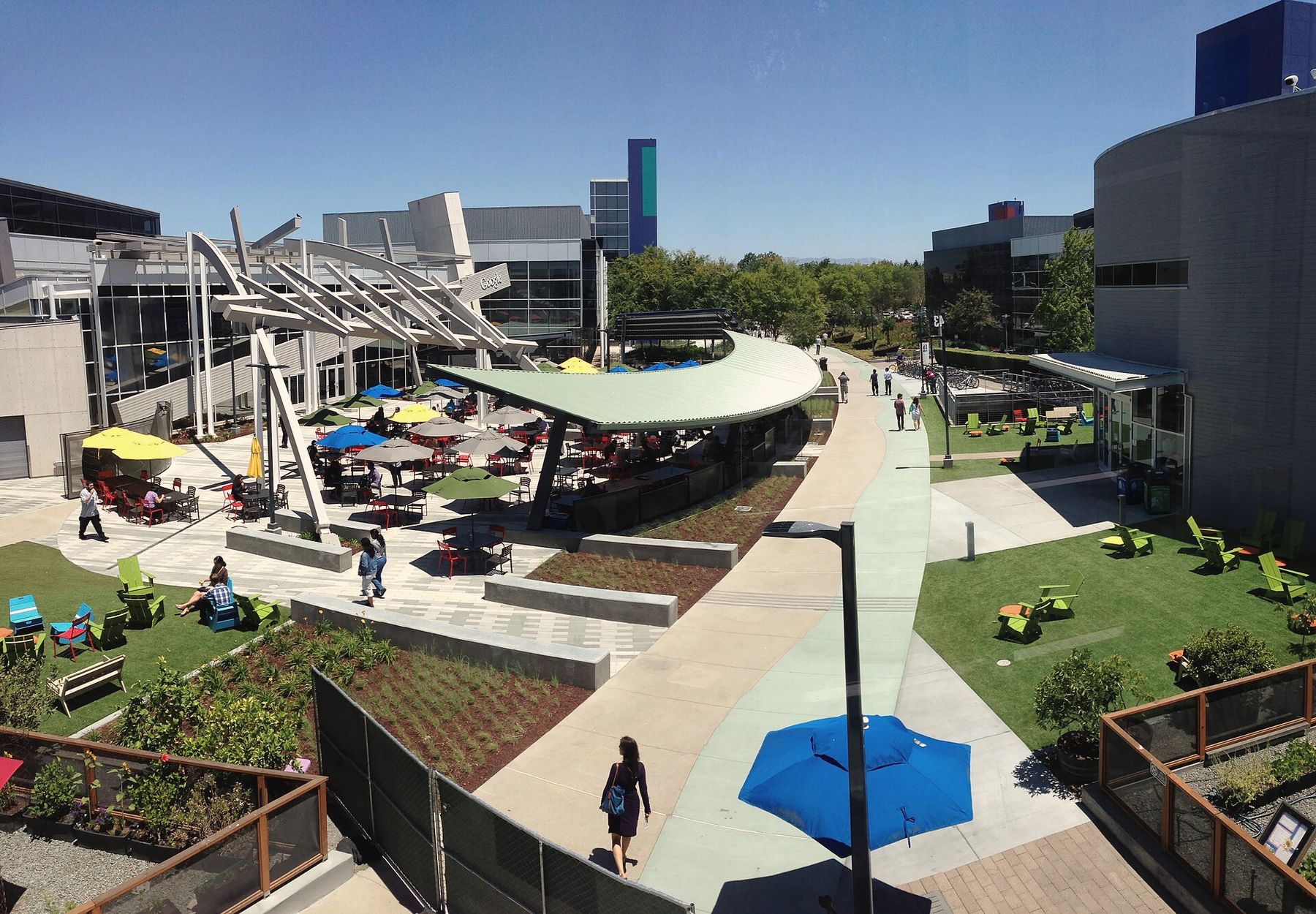
What this coveted new lifestyle looks like can be discerned by observing the top tiers of employer market. Big tech companies like Google or Facebook have organized their operations to reflect what the cream of job-seeking demographic finds as most appealing — living/working arrangements. In these functioning tech-utopias, where much of all needs are conveniently provided for, creativity and productivity reign supreme, with a laid back approach to working hours and dress codes, more flexibility in scheduling and a better work-life balance. This is what ranks them among most desirable employers. Job security and base pay rank invariably high on the priority list, as is to be expected, however other factors, like “recognition for job well done”, “working with highly talented peers”, “corporate culture and values”, are gaining strongly in importance. Creatives seek challenging work which will allow them to develop their skills, gain recognition from their peers, look good on a resume and afford them the improved prospects for future employment.
The atmosphere of uncertainty in the job market is reflected in the changing attitudes towards work. Creatives seek jobs which will benefit them individually in the long run, and are willing to compromise on base pay and other traditionally higher priorities. Much more responsibility for one’s own career is taken, which is carefully self-managed. Thanks to liberating effects of technology, work has become highly mobile. To increase efficiency and avoid overhead expenses, work is increasingly done at home or in public places such as cafes, airports, libraries etc., in other words almost anywhere where it’s still deemed socially acceptable to linger for a few hours for the price of a cup of coffee. These changes are also gradually transforming office culture. As company hierarchies have become flat, workers are losing interest in climbing the corporate ladder. Workers in the creative sector associate themselves more with their profession and occupation than with the company. Rather than moving vertically through the ranks, they tend to move laterally, occupying the same position in different organizations. The careers in this sector tend to be front loaded, meaning people designate their most work-intensive years to the beginning of their careers, when they are most energetic and the potential for advancement is at its peak. This often means the willingness to relocate according to job opportunities, while all these factors cumulatively contribute to postponing marriage and bearing children.
Moreover, the culture as a whole is experiencing a revolution in content production and self-expression, regardless of occupation or age. Mostly attributed to the democratization of tools and exponential availability of means for producing content, the once elitist domain of content creation has now become the popular norm. Some argue more pessimistically, that the reasons behind the phenomena such as selfies also has much to do with the fragmentation of society and breakdown of social bonds, where there is rampant loneliness and individuals try to somehow reify and attest their existence through the creative act. The undisputed reality however is that unprecedented numbers of people are taking up creative work, whether it’s making and marketing home-made jewelry, graphic design, photography, making music or art, all of them hoping to go viral and be the beneficiaries of Internet’s fickleness.
In the entrepreneurial domain, tech-savvy individuals are making good use of their skill set and market opportunities, built on digital ecosystems such as the YouTube, iOS or Android. This should be of little surprise considering the low initial costs and the potential for large return on investment if the project is successful. Led by college dropouts’ patron saints, Gates, Jobs and Zuckerberg, droves of young people with an acute understanding of the digital-social culture and the current market are hard at work on the next big thing. On the opposite side of the table, lured by the prospect of owning a large chunk of a future-Facebook or Twitter and cashing out, wealthy individuals are ever more willing to invest capital into tech ventures. These two groups are in search of each other.
Creative work can be the next object of desire on display.Chapter four
The Internet made both marketable and feasible products and services which were previously insufficiently lucrative to have a physical presence. As a way to curb unnecessary overhead costs, professionals and service providers are collectivizing into a new type of work space — coworking space. Tailored to immediate needs, a private individual or business can rent out anything from a single desk in a common room on an hourly rate to a private office for a much longer term. By paying a fee for a temporary arrangement, small businesses can have access to amenities they couldn’t afford on their own. In this aggregate economy of scale, amenities such as fast and reliable internet, large format plotters, 3D scanners and printers, copy machines, video and audio production equipment etc. become available to the many. Professionals in related fields often find this kind of work setting both convenient and stimulating. The social component of workplace makes working much more pleasant and the atmosphere motivational. These semi-formal working spaces can range anywhere from a conventional cafe, to full-on office space, and every mutation in between. The underlying criterion being cost cutting and convenience. More importantly, such small businesses also have access to meeting rooms with projection equipment, suitable for holding presentations away from home, in a more professional and technically capable setting.
Just like Victor Gruen once took the goods out of shopping windows and put the act of shopping itself as the displayed object of desire, creative work can be the next object of desire on display. In a manner described by René Girard, the creative elite will in effect be the advertisement for this behavior, and will mimetically create the desire in others who will want to imitate or emulate it. Coworking spaces and creative cafes are infrastructurally undemanding and can be applied in a variety of spaces, and would be a programmatic asset to most city center malls.
Place
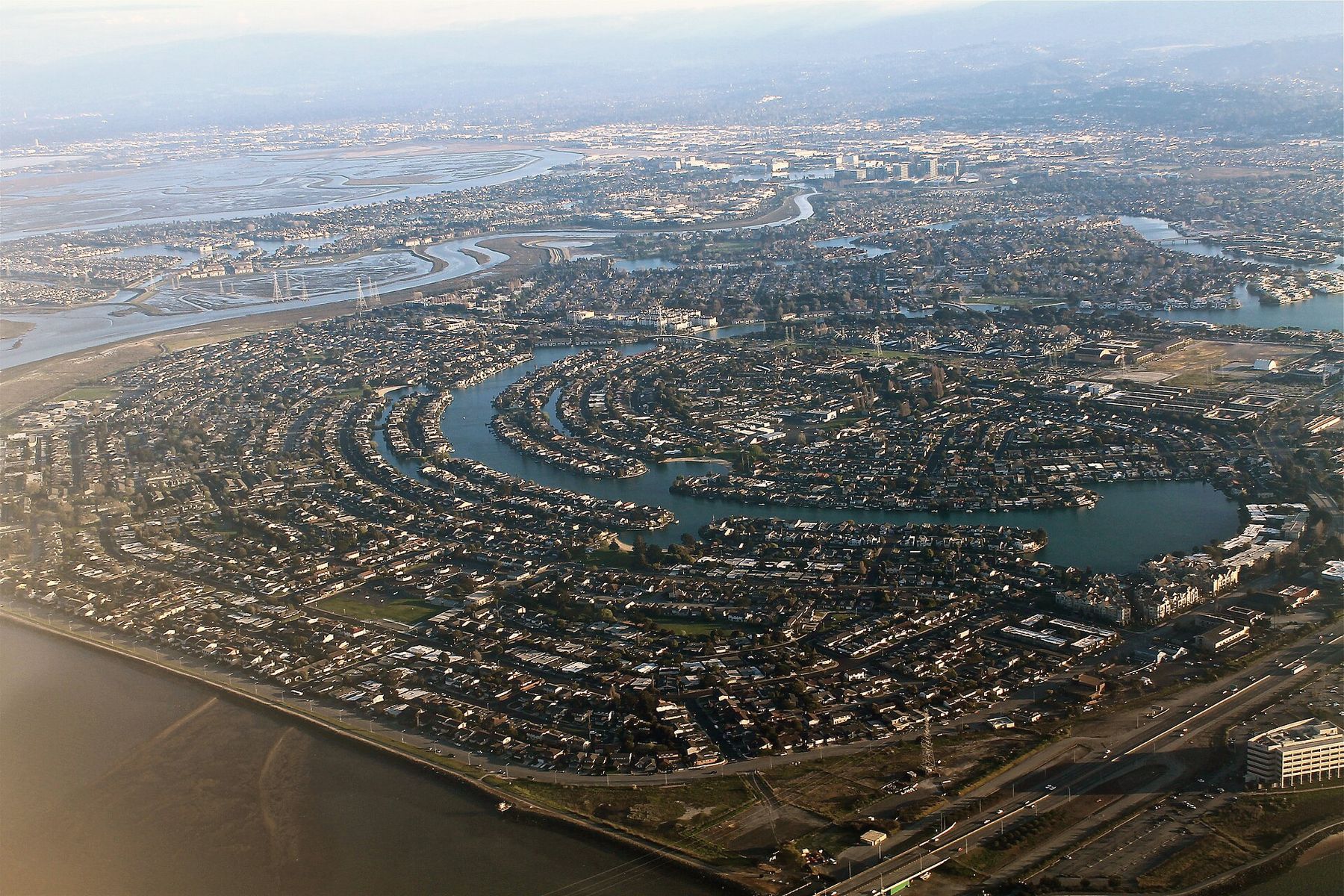
Some overzealous pundits have hailed the advent of the internet and the social (media) as the end of geography. Some claim that social networks are replacing actual communities and that physical space has lost its relevance. However, rather the opposite is true. With the weak social bonds and “company man” attitudes at an all-time low, traditional organizations are losing preeminence as a hub. In the economy of high lateral mobility and costs of self-organizing reduced to virtual zero, the location itself is the single most important organizing unit. This fact can be attested by various industries which have always clustered in certain locations. The places have moreover become synonymous with the industries, such as Hollywood or New York-Paris-Milan, not to mention Silicon Valley, the techiest of them all. Contrary to the world becoming flat, as some put it, cultural, economic and political boundaries are still very much a reality and need to be taken into serious consideration. Legislative frameworks and the availability of investment capital make real, consequential differences between one place and another. This is why, in this allegedly post-geographic age, areas such as Tech City London happen in certain locations while in others they do not.

Physical space and presence remain still largely unchallenged as a collaboration realm.Chapter five
Software and digital communication have done much for sharing. Sharing, however, as a level of collaboration, is relatively easy to achieve and is very limited. There are two more levels of collaboration beyond sharing, namely cooperation and collective action. Physical space and presence remain still largely unchallenged as a collaboration realm, particularly in the creative field where inspiration, intuition and serendipity play a considerable role. This is why coworking / sharespace businesses are on the rise. In terms of retail, the importance of physical space can be attested by companies like Apple. Apple decided to take more control of their brand image, which had much to do with product presentation and their customers’ shopping experience. Apple opened a global chain of retail stores, which soon became the most profitable retail space per square foot in America, ahead of jewelers Tiffany & Co. Even with companies that have no physical product, such as Google, a physical presence has a substantial impact: Google struggled to obtain market share in Russia and after making a physical presence, their market share doubled.
To elaborate on the importance of place, we submit the following hypothetical scenario. To start, consider the following question:
If, like Apple, Facebook opened a chain of retail stores — what would they be?
Why then doesn’t Facebook build embassies?
Sure, Facebook is great for keeping in touch with people we’ve already met. Statistics show in fact that on average 84% of Facebook friends are from the same country, and 89% are people we’ve met more than once. Facebook of all companies has the insight to know who its members are and what they are interested in, but it has done very little towards bridging the social gap and connecting new people together. Let’s put it this way: if Facebook were a GPS device, it would tell you where you are, but not how to get where you want to go. Facebook is mapping out the social landscape but is doing very little to help its users actually navigate it and successfully get to desired destinations. Why?
Part of the reason might have to do with the fact they haven’t found a model to successfully monetize this service, as they currently sabotage their existing service by selling ad space and user data to other businesses. If Facebook had a worldwide retail chain, however, their monetization model could expand from the current business-2-business to business-2-customer and even customer-2-customer model.
The fact is that Facebook’s demographic is rapidly aging. The young are moving on to greener pastures such as Instagram and Snapchat. Facebook’s demographic growing old doesn’t however mean that Facebook has grown up or become more useful. The fact is that the cool kids, the early adopters, don’t want to be on Facebook — they want to work for Facebook. And they should, in a way. Facebook started out with the unstated promise of bringing the college experience to its users. Now that they’ve matured as a company, Facebook should make good on that promise: they should build a chain of Facebook campuses around the world — for their users.
Since the industrial revolution, the cause of almost every large private fortune came from finding a way to commoditize and offer to general public something previously available to the few. The experience of working for a big tech company can be recreated in the aggregate, an experience which could readily be commoditized and sold. Contemplating this possibility opens up various interesting scenarios.
Offering an integrated social-software and physical workspace platform would allow Facebook to connect people to people. In terms of collaboration this would make possible to go beyond sharing, to cooperation and to collective action. An integrated array of coworking spaces, accommodation, shopping and various services would make a campus-like platform for decentralized task driven collaboration and project development. These campuses or embassies, strategically placed and connected around the globe, would facilitate the flow of competencies and development of ideas, creating clusters of opportunities in new, untapped talent markets.
Facebook’s massive 1,590 million user base can be leveraged heavily with compounding effects. Every user would take on several roles in relation to projects. The same user who is the creator of one or several projects would kickstart i.e. fund another project. The user who funded one project would be the consumer of yet another project. All of the users would help sort and rank various projects and users, in terms of how much interest there is for them. In this system the whole 1.59 billion user base is creating projects for itself, funding them, developing and manufacturing them, marketing and consuming them. All to itself, all one and the same user base.
Tourism
The described case study scenario is relevant because it does not apply only to Facebook or Google and such. The same effect can be recreated in the aggregate. Companies in other fields — whether it’s the tech world with insight into the social sphere, hotel business, travel business or commercial development can recreate this “embassy effect” by taking advantage of tourism. 1.56 billion, a number similar to Facebook’s user base, is the projected number of tourists in 2020 according to World Tourism Organization. 1.18 billion of those are projected to be intraregional and 337 million long haul. Tourism is a rapidly growing industry pivoting around place. From 1950, the era of the first shopping mall, to the year 2000, international tourist arrivals already increased from 25 million to 700 million — a 28x increase.
“From 1950, the era of the first shopping mall, to the year 2000, international tourist arrivals already increased from 25 million to 700 million — a 28x increase.”
The UNWTO counts 25 million arrivals in 1950 and 674 million in 2000: about 27 times.The mall was originally a success because it took already existing social and technological circumstances and simply assembled them in a new way. Today there is an opportunity to achieve the same effect with the pieces now available. The current parameters have to do with the changed social landscape and culture, new attitudes toward work and shopping, and with the increasing role of technology in daily life. One other trend which can advantageously be employed in the re-imagined mall is the rapid growth of tourism. Presently ancillary tourist services, those which derive 25-50% of income from tourism, like wholesale and retail businesses, electronic entertainment, transport manufacturers, artists, writers, advertising agencies, event management, printing works, self-employed professionals etc., or services such as port companies, cosmetics industry, universities, private training institutes, architects/developers which derive up to 25% from tourism, could benefit most from deep integration with tourism and travel.
Experts are effectively catered directly to tourist destinations, at their own expense.Chapter six
As a rule the socio-cultural impact of tourism is generally thought of as negative. The presence of tourists who are less inhibited when on holiday and whose behavior is at odds with the local cultural norms diminishes the authenticity of the destination. The shift begins with recognizing the limitations of the label “tourist”. “Tourist” is a label that fails to appreciate any value other than purchasing power. A person traveling abroad regardless of their qualifications, be they an educator, an artist, business man, publisher, writer or Nobel laureate, usually finds themselves reduced to this non-descript, almost derogatory category of tourist. However, when effectively employing their intellectual and social value, former “tourists” can become visitors which actually enrich and benefit their respective destinations. Experts are effectively catered directly to tourist destinations, at their own expense: all that is needed is to create a model to take advantage of this circumstance.
Leveraging information technology and mobile devices, the social gap can be successfully overcome. Using a dedicated social app, users could not only meet potential business associates online, but conveniently book coworking space, presentation rooms or venues. By creating a hub, an array of spaces for working, shopping, entertainment, accommodation, events and culture, this hub can serve as an interaction catalyst between the incoming talents and local competencies, where visitors not only consume but contribute and perform.
Future services
The product of the tourism business is unique in some respects: it is bought for consumption often many months in the future and many miles away from the point of purchase; it also usually takes up a substantial role in a person’s or family budget and involves an element of novelty and the unknown as actually desirable. It’s essentially an intangible service which cannot be pre-tested, so there is a factor of risk involved. Consequently establishing a distinct and recognizable brand is of importance. When in an unfamiliar surroundings, customers go for what they know, for brands they recognize and trust. Branding a tourist product builds the necessary confidence with the customer. In order to establish a global network of facilities suitable for leisure and recreation, but also for work and collaboration, the tourist product would benefit most by being set up as a franchise. Regardless what segment of the market it’s intended for, a franchise gives the crucial reassurance to the consumer without necessarily divulging too much about the product. Tourist brands, or rather franchises, give the consumer the confidence to commit, relying on the franchise recipe to deliver a pleasant and consistent experience and service.
Predictability, while undesirable in some aspects of tourism is crucial in others, such as cleanliness, quality of service, core service pricing etc. When these parameters are rigorously adhered to in a franchise, other parameters can vary to a considerable degree, thus offering unique and exciting configurations of services and spaces. Predictability, consistent quality of ambiance and service is key for attracting the demographic focused on work. If the consumer can rely on the franchise to provide consistent working conditions regardless of location, the idea of bringing work anywhere and being truly productive anywhere in the world becomes possible.
As the social landscape changes, the mall’s services need to address ever broader aspects of life — work, health and fitness as well as entertainment and shopping. Dwelling as well is in the grey zone, especially for those who spend much time abroad. Just as the mall was once a commercialized, service-saturated surrogate for community space, it can exploit this market and offer a global, service-saturated surrogate of a home — home+. It is well within the possibility of a franchise not only to offer working globally but franchise living globally. With the restructuring of family life, activities that were once provided within the household like cooking, cleaning, various maintenance and such, fall on the shoulders of the individual. Young unmarried professionals value their time disproportionately to the perceived value of doing chores. When not working, they spend time relaxing, working out or hanging out, instead of doing housework, because rest and entertainment are seen as an integral part of work performance. These circumstances are an opportunity for the service sector. The most convenient living arrangements, therefore, would involve an extension of basic rent of dwelling space to include services like cooking/catering, cleaning, laundry etc. in a single price package. Geared toward dynamic, mobile, tech-driven lifestyles, accommodation packages could range from conventional room or suite accommodation to arrangements such as capsule hotels.
In this business model the franchise is scalable, with each strategically placed unit i.e. campus or “embassy” being able to operate self-sufficiently and as a network node. Tailor made each for particular locale as an architectural hybrid, each unit could offer the possibility for variable ownership structure, degree of autonomy, each with its own mix of services and facilities, and generating its own revenue. However, because of its global nature, interesting possibilities for new services open up. Services such as cloud living, for example, thanks to which users need not miss a beat when relocating from one franchise location to another: all their living and working arrangements could be stored in the data bank and reproduced before their arrival at any other destination. Using the dedicated social app, users could book rooms and coworking space, presentation rooms or venues. Checking in, a customer would find everything already set up to their taste and preference, with a unique local flavor.
A global education/business platform, a robust node-network, decentralized and distributed.Chapter seven
Bitcoin, Facebook credits or some other digital currency, existing or proprietary, could use such a franchise as a spring board. Digital credits could be used as the means of compensation for work, while being expended for purchase of goods and services, such as coworking space, accommodation, access to events and lectures, health and fitness facilities etc. The franchise branches would in turn benefit from the turnover. These tangible, real-world incentives would increase the value and desirability of digital currency, consequently attracting more adopters and boosting in-house productivity, online activities, advertising, content production and trade. With all the economic activity within the franchise, there would be also an opportunity of growing and streamlining the startup-incubator business model to global scale, giving the franchise an unparalleled insight in the startup realm, allowing the pick of the litter, in talent recruitment and in venture projects, allowing for very early buy in while reducing risk. Using digital currency and an in house incubation framework, intricacies of various local legislative obstacles and red tape could perhaps be circumvented. In-house financing or crowdsourcing framework could be offered in places legislatively unfavorable for start-up businesses. Taking a stronger role in finance, such a franchise would be able to take venture capital and crowdsourcing into a new era: its users could not only kickstart others’ projects by donations, but in fact users investing credits in projects could own quasi-shares in the venture and be paid dividends in digital currency. Using the dedicated social app, users could check on their investment “stock” and credit balance. Using the dedicated social app they could also then expend their credits on goods and services. All within the franchise.
Few aspects of life remain unaltered in the recent years and education is no exception. The future of education is as unclear as ever. The accelerating evolution of disruptive technologies is shifting ground beneath many occupations and professions. In many fields traditional educational institutions and their students are struggling to anticipate what the job market will be 4-7 years down the line, which now seems a very long time. The burdening cost of high education and its duration drives many to rather seek acquiring practical knowledge and specialist skills since a college diploma no longer guarantees employment. Rather than attending college and acquiring a broad knowledge base, more people choose investing the equivalent time on building references and honing narrow expertise, which is what employers are looking for. Studies show that professionals in the creative sector spend on average 13.5 hours/week of unpaid time on self-educating in order to stay competitive. Education, therefore, is a growing market.
If the inertia of traditional institutions in the developed world makes the case for an organic, third party driven education, it is made even more so in the developing world. In the emerging markets traditional educational infrastructure is often wholly absent. With emerging formats such as Khan Academy or TED talks etc., the gulf between being a pupil and an educator is ever narrower. Successful specialists are promptly given the limelight, and are just as promptly replaced with someone whose content is deemed more valuable. Harnessing the growth of tourism, a user driven curriculum built on an integrated platform can bring state-of-the-art learning opportunities anywhere on the globe. Education would facilitate the local solutions for local problems, growth of local economies and competencies without the need for charity. Successful models could then readily be copied, adapted and employed globally. Local needs could be addressed with grassroots entrepreneurial movements and the local knowhow. A global education/business platform, a robust node-network, decentralized and distributed. Using the dedicated social app, users could purchase tickets to events or be themselves engaged to speak, perform and collaborate. Their engagement would be paid in digital credits.
The future of customer relation is social, whether it’s business-2-customer or customer-2-customer mediated by business. The future of social in turn, is about more than any particular product or service; it is about building a culture. It’s a holistic approach to users’ needs and desires. With scale, the possibilities become almost limitless. With a globe spanning franchise of “campuses”, “embassies” or whatever the name, the franchise could have its own lineup of ambassadors and celebrities. It could offer endorsement contracts to their star-users, engaging them for lecturing tours, workshops and appearances in order to attract other users, the general public and bank on admission fees, services and retail. A new constellation of Elon Musk type of celebrities, the creative, entrepreneurial superstars, and tiers of sub-rank endorsees making a living by doing what they most love doing: traveling, working and lodging in spectacular places. That is the brand. Young talents from all around the world, even in direst of circumstances, would have a hope, a powerful new dream to pursue, a strong incentive to help themselves by helping and contributing to the community — the local community and our one, global community.
…the local community and our one, global community.
Addendum
Every idea below was already in the 2016 proposal. The full explanation went beyond the competition brief, so it was kept apart rather than submitted. Over the next five years the concept was developed further, with clarifications and examples. Its name is borrowed from the article’s question to Facebook: Embassy, now a standalone business model.
About this document
- Competition
- International Shopping Plaza Concept Competition, first edition (2015–16), “Commerce Changes Cities”
- Organizers
- Wanda Commercial Planning & Research Institute and the Architecture and Culture Society of China; co-hosts China Building Centre and Tongji University College of Architecture and Urban Planning
- Jury chairs
- Daniel Libeskind (professional) · Iñaki Ábalos (student)
- Category
- Professional
- Deadline
- 10 March 2016; results April 2016
- Author
- IGV · Ivan Gavran Vlahović, dipl. ing. arh. · igv.hr
The essay is reproduced in full from the submitted booklet. Pull quotes repeat sentences from the text.
The figures were made for this page in 2026. Every number in them is sourced below. The addendum draws on a presentation made a year or two after the competition. Photographs are credited in their captions and listed below.
vLAB, the prototype for the Embassy-type hybrid, was the case study in the original proposal: vlab.igv.hr.
Original PDF ↗Sources for the figures and notes
- Montgomery Ward, mail order from 1872. Wikipedia
- Southdale Center opens, 8 October 1956. History.com
- Amazon opens online, 16 July 1995. Wikipedia
- Facebook Reports Fourth Quarter and Full Year 2015 Results, 27 January 2016. Facebook; TechCrunch
- UN World Population Prospects 2015: China 1,376 m, India 1,311 m. UNCTAD
- UNWTO Tourism Highlights 2017, arrivals 1950–2016. PDF
- WTO Tourism 2020 Vision, 1.56 bn arrivals by 2020. PDF
Photographs
- Southdale, late 1950s. Colourpicture Publishers, public domain. Source
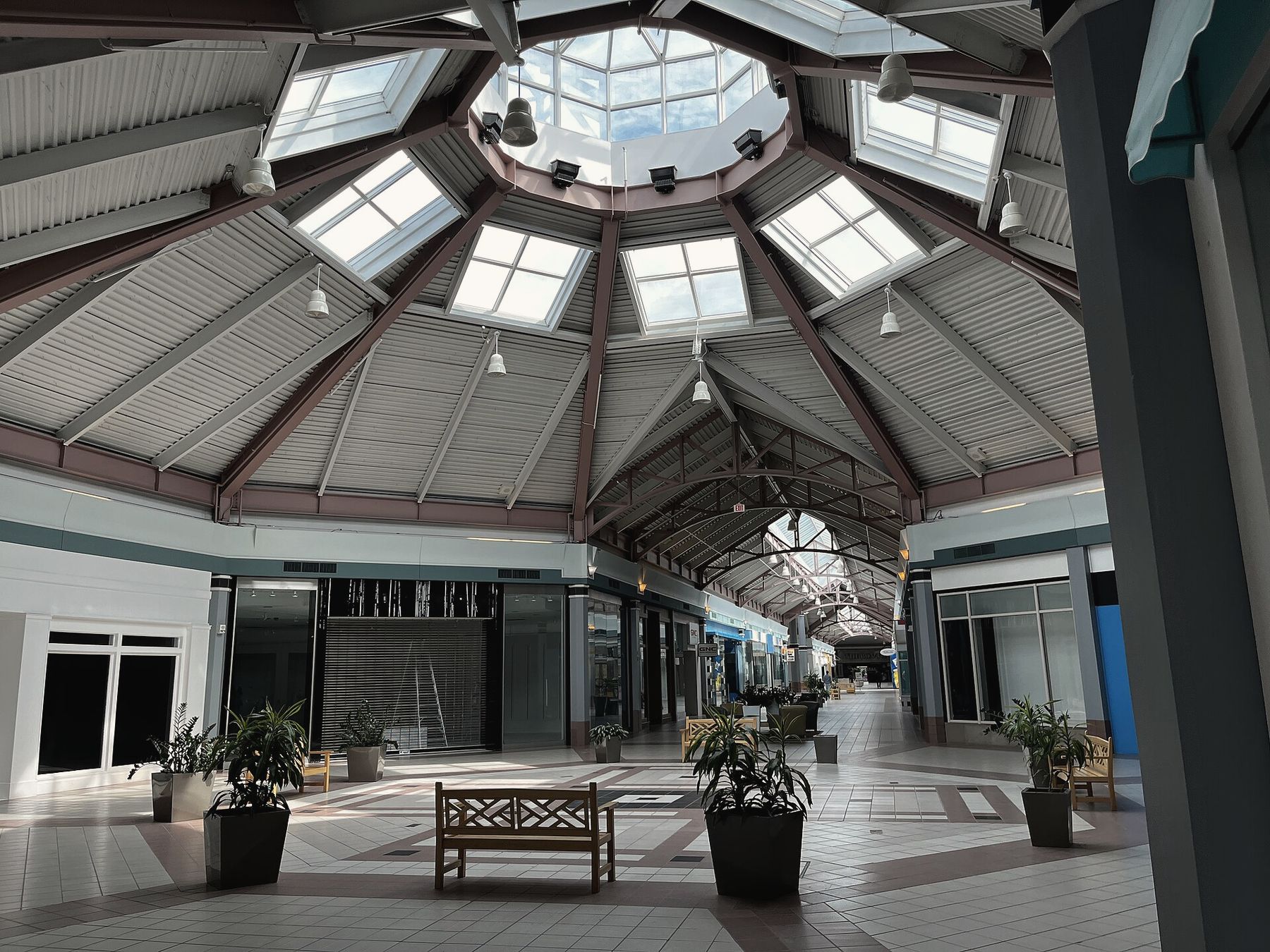
- Steeplegate Mall, 2022. Photo: JJBers, CC BY 2.0. Source
- Levittown, c. 1959. Public domain. Source
- Googleplex, 2014. Photo: Runner1928, CC BY-SA 3.0. Source
- Silicon Valley, 2013. Photo: Patrick Nouhailler, CC BY-SA 2.0. Source
- Rockefeller Center, 1933. Samuel H. Gottscho, 1933, Library of Congress, public domain. Source
- Downtown Athletic Club, 1930. Photo: Americasroof, CC BY 3.0. Source
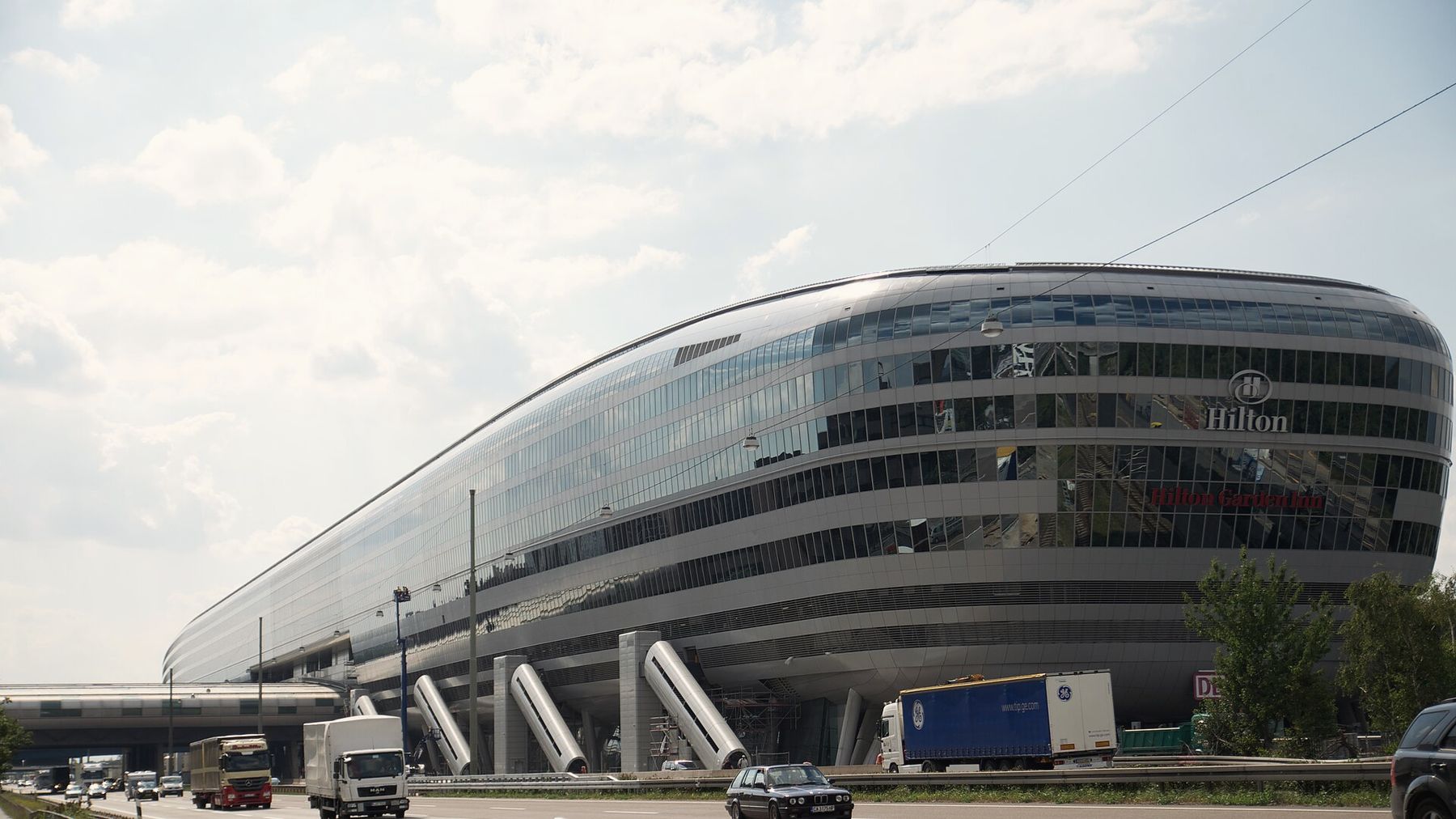
- The Squaire, Frankfurt. Photo: Lostinbass, CC BY-SA 3.0. Source
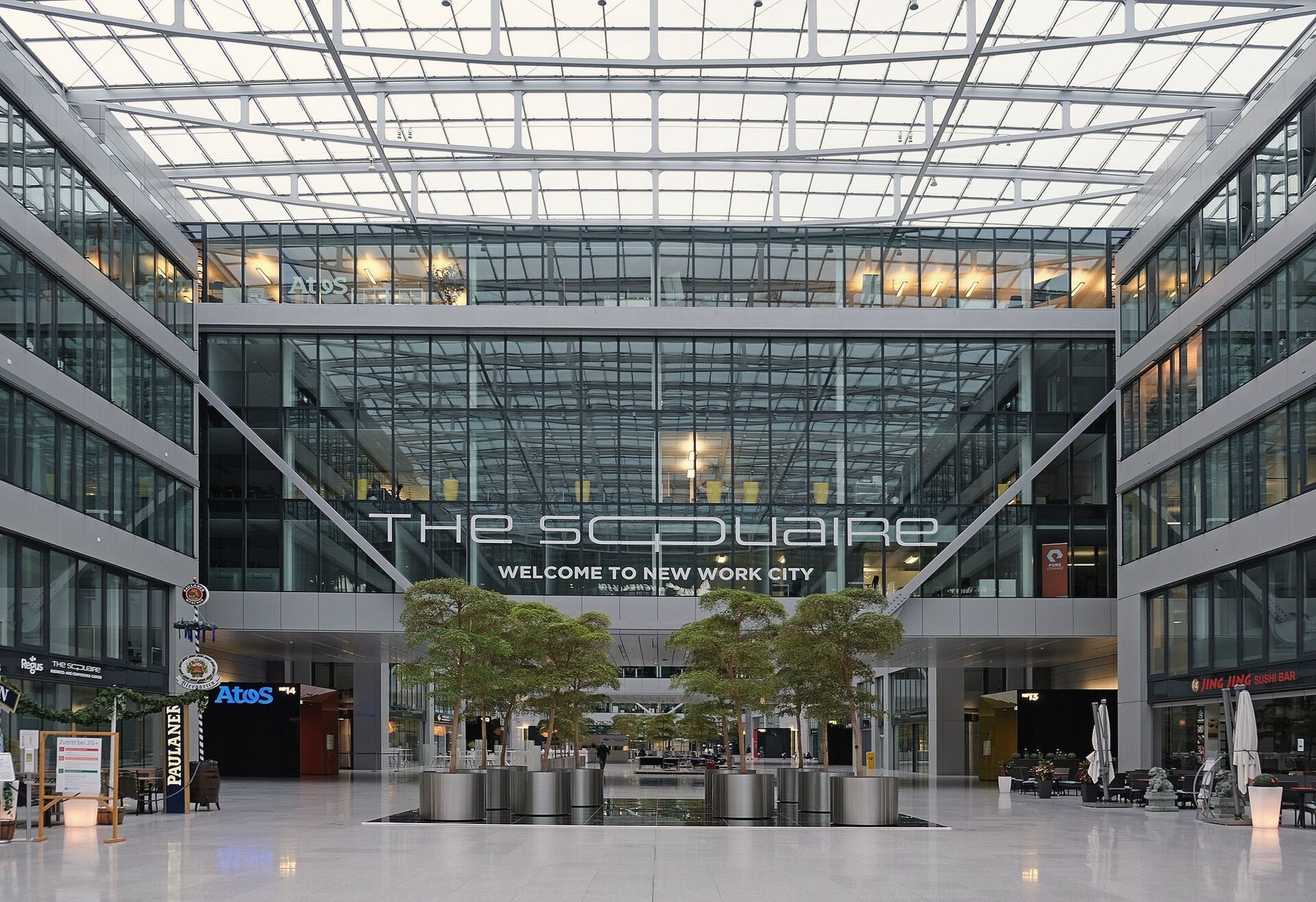
- The Squaire, 2022. Photo: kallerna, CC BY-SA 4.0. Source
- 1950. Photo: Willem van de Poll / Nationaal Archief, CC0. Source
- 2019. Photo: dronepicr, CC BY 2.0. Source
- Montgomery Ward & Co., 1875. Montgomery Ward & Co., 1875, public domain, via Internet Archive. Source
- Victor Gruen (1903–1980). American Heritage Center, University of Wyoming (not free). Source
- 10 Corso Como, Milan. Photo: LucaChp, CC BY-SA 3.0. Source
- Robert Venturi (1925–2018). Photo: Todd Sheridan, CC BY-SA 2.0. Source
- Raymond Hood (1881–1934). Public domain. Source
- Coworking, 2015. Photo: Eugene Kim, CC BY 2.0. Source
- René Girard (1923–2015). Photo: Vicq, public domain. Source
- Fifth Avenue, 2010. Photo: Jorge Láscar, CC BY 2.0. Source
- Menlo Park, May 2012. Photo: Kevin Krejci, CC BY 2.0. Source
- Stradun, Dubrovnik. Photo: Alex Proimos, CC BY 2.0. Source
- Capsule hotel, 2017. Photo: Trueshow111, CC BY-SA 4.0. Source
- Bitcoin, 2013. Photo: Steve Jurvetson, CC BY 2.0. Source
- TED, 2011. Photo: Steve Jurvetson, CC BY 2.0. Source
- 29 May 2014. Photo: NASA/Dimitri Gerondidakis, public domain. Source


Cover
Article, p. 1
Article, p. 2
Article, p. 3
Phase 1
Phase 2
Phase 3